

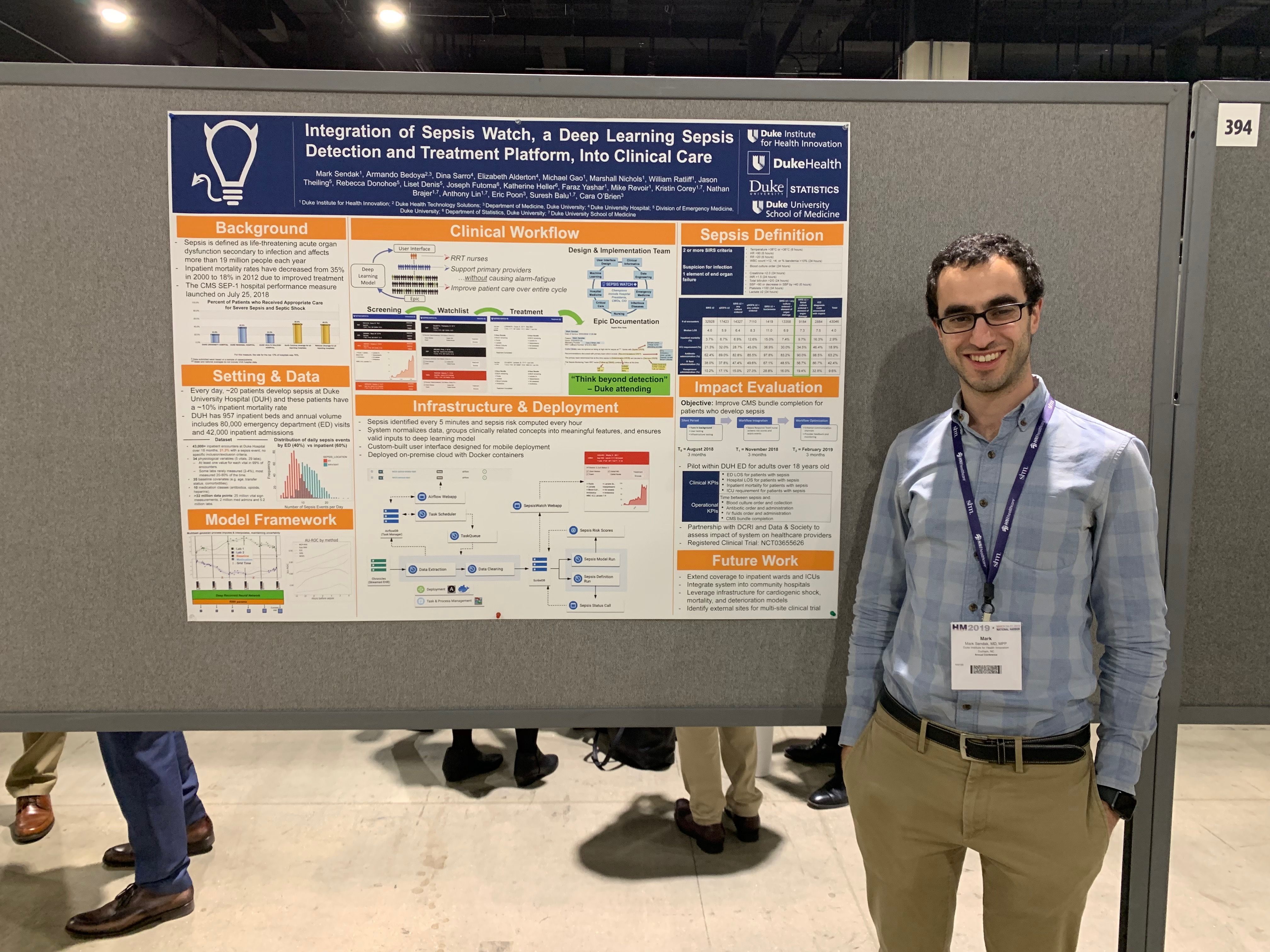
Insight: Workflow localization is non-negotiable. The right alert, to the right person, at the right moment [for the right patient] is crucial for the success of an AI/ML solution in a healthcare delivery organization. Implementation requires discovery and thoughtful integration, not blind deployment.
At a Glance — Why do so many clinical AI solutions fail to achieve adoption even when the underlying model is accurate? Because accuracy and usability are different problems; an alert reaching the wrong person at the wrong moment goes unused regardless of how well the model performs. What made Sepsis Watch™ different from the early warning tools Duke clinicians were already using? The existing tool generated so many false alerts that clinicians dismissed 86% of them; Sepsis Watch™ was designed around the Rapid Response Team's specific workflow, changing the trust dynamics of the entire system.
Sepsis is the leading cause of mortality in U.S. hospitals. A 2025 report to Congress by the Agency for Healthcare Research and Quality (AHRQ) found that from 2016-2021, sepsis-related inpatient stays rose from 1.8 million to 2.5 million, a nearly 40 percent increase.
Sepsis requires timely intervention and coordinated execution; when managed poorly, it creates significant clinical and financial burden for healthcare systems. For executives, sepsis is a patient safety, quality, and reimbursement issue that demands disciplined operations and precise care.
In 2018, Duke University Hospital went live with Sepsis Watch ™, a machine learning model that uses real-time physiological and medication data to accurately predict the onset of sepsis. It was the first deep learning model integrated into routine clinical care in the United States.
From 2018-2023, Duke University Hospital increased Sep-1 bundle compliance, an important Medicare quality metric, by 89%, and decreased sepsis mortality by 29%.
Seven years later, Sepsis Watch ™ remains in continuous operation across all three Duke Health hospitals — Duke Raleigh Hospital, Duke Regional Hospital, and Duke University Hospital — making real-time hourly predictions for adult patients. Its durability stems from the focus on the on-the-ground realities of clinical teams detecting and treating sepsis.
The experience implementing and maintaining Sepsis Watch ™ surfaces critical lessons in how to create organization-wide change in a health system and informs how Vega Health approaches partnerships with our health system customers.
The Real Innovation is the Workflow
Sepsis Watch™ was incubated within the Duke Institute for Health Innovation (DIHI), Duke’s internal innovation arm. DIHI transforms care delivery by bringing innovation strategy to workflow design. Its portfolio of ambitious initiatives, many of which are powered by AI/ML, are informed by real-world problems faced by Duke clinicians.
The group laid the foundation for an innovation like Sepsis Watch™ through earlier initiatives, like extracting clinically relevant signals from the electronic health record (EHR) and standardizing them at scale. This created the data foundation required to move from promising algorithms to durable, operational impact.
Sepsis Watch™ was conceived of and developed from 2015 to 2018, a period that coincided with rapid advances in machine learning methods, including the emergence of recurrent neural networks (RNNs). But the team was not just building a model; they were building the data pipelines, cleaning protocols, and institutional scaffolding needed to make a real-time model actionable.
To wrap around the model, DIHI built tooling to support a silent trial prior to launch, monitor the model after launch, and education materials to support adoption by front-line workers; a dashboard to display information on high-risk patients, facilitate the clinical workflow, and monitor the delivery of sepsis treatment bundle elements; and a quality improvement tool to track key performance and utilization metrics in real-time and facilitate continuous improvement.
Sepsis Watch's early success at Duke University Hospital had as much to do with the scaffolding built around the model as the development of the underlying model.
Clinical teams don’t want to be overwhelmed with alerts that distract them from the care they are providing. Before Sepsis Watch ™, Duke clinicians relied on the National Early Warning Score (NEWS) as a proxy for identifying sepsis, but the volume of false alerts caused the clinicians to dismiss 86% of them.
The early results made the contrast clear: Sepsis Watch ™ materially outperformed NEWS. The deep learning model predicted sepsis at a median time of 5 hours before clinical presentation and was estimated to save about 8 lives per month.
The solution was designed with clinicians and their workflows in mind, enabling rapid triage, reassessment, and treatment of sepsis, rather than just detection.
"Think beyond detection,” Will Ratliff, a project manager at DIHI, said. “Detection is a problem — there are cases that get missed. But the treatment protocol itself is exacting, with many steps, many points of failure. Treatment support is equally important."
DIHI integrated Sepsis Watch ™ into the workflow of the Rapid Response Team (RRT): a clinically experienced, highly trained nursing team with the capacity and clinical expertise to act on the model’s outputs.
This design decision significantly influenced the trust dynamics regarding the solution and contributed to its adoption and eventual success. Emergency department (ED) physicians were already managing substantial cognitive demands. Therefore, introducing Sepsis Watch ™ to the RRT enabled trusted nurses to present urgent issues directly to ED physicians
"The trust at that point in time was not between the physician and the model — it became trust between the RRT nurse and the ED physician,” Suresh Balu, DIHI’s executive director, said. "This change influenced the entire approach."
Once trust was established, Duke was able to expand the reach of the model to automate direct notifications to nurses across other hospitals and units — including two community hospitals, Duke Raleigh Hospital and Duke Regional Hospital — each with workflow configurations localized to that site's context.
DIHI’s workflow integration features site-specific notification routing to the right clinician at the right moment and real-time nudges that alerts the right team member when patients requirefurther treatment steps, like IV fluid administration.
The notifications and nudges balance the other competing priorities within a busy hospital environment, ultimately enhancing overall time management.
Beyond notifying clinical teams about the risk of sepsis, one of DIHI’s explicit goals for building Sepsis Watch ™ was to track compliance with documentation and treatment standards forreporting to payors. The platform streamlines the muti-step sepsis treatment process and reduces variation in sepsis care across hospitals.
Because DIHI was working hand-in-hand with clinicians to understand their unique challenges with sepsis, they were able to build a platform and coupled workflows that addressed those problems. In other settings – like community hospitals -- detecting sepsis is as much of a priority as having a platform to manage the treatment.
Introducing and integrating a model like Sepsis Watch ™ into a new setting requires a nuanced and tailored approach specific for each institution.
Part 2 will explore the validation of the model in a different clinical setting and the challenges with replicating the success of Sepsis Watch ™ at another care delivery organization.