
And other insights from our Raleigh-Durham Startup Week panel on building trust with healthcare AI
That quote came from Kimberly Coston, a cardiovascular ICU nurse at Duke and engineering graduate student, about twenty minutes into our panel on Wednesday evening. It echoes something our CEO, Dr. Mark Sendak says often around the office: there’s a difference between integrating a solution into an organization, and deploying one against the organization. Kim's insight landed the way the best observations do: obvious in hindsight, but rarely said out loud.
It became, in a lot of ways, the thesis of the night.
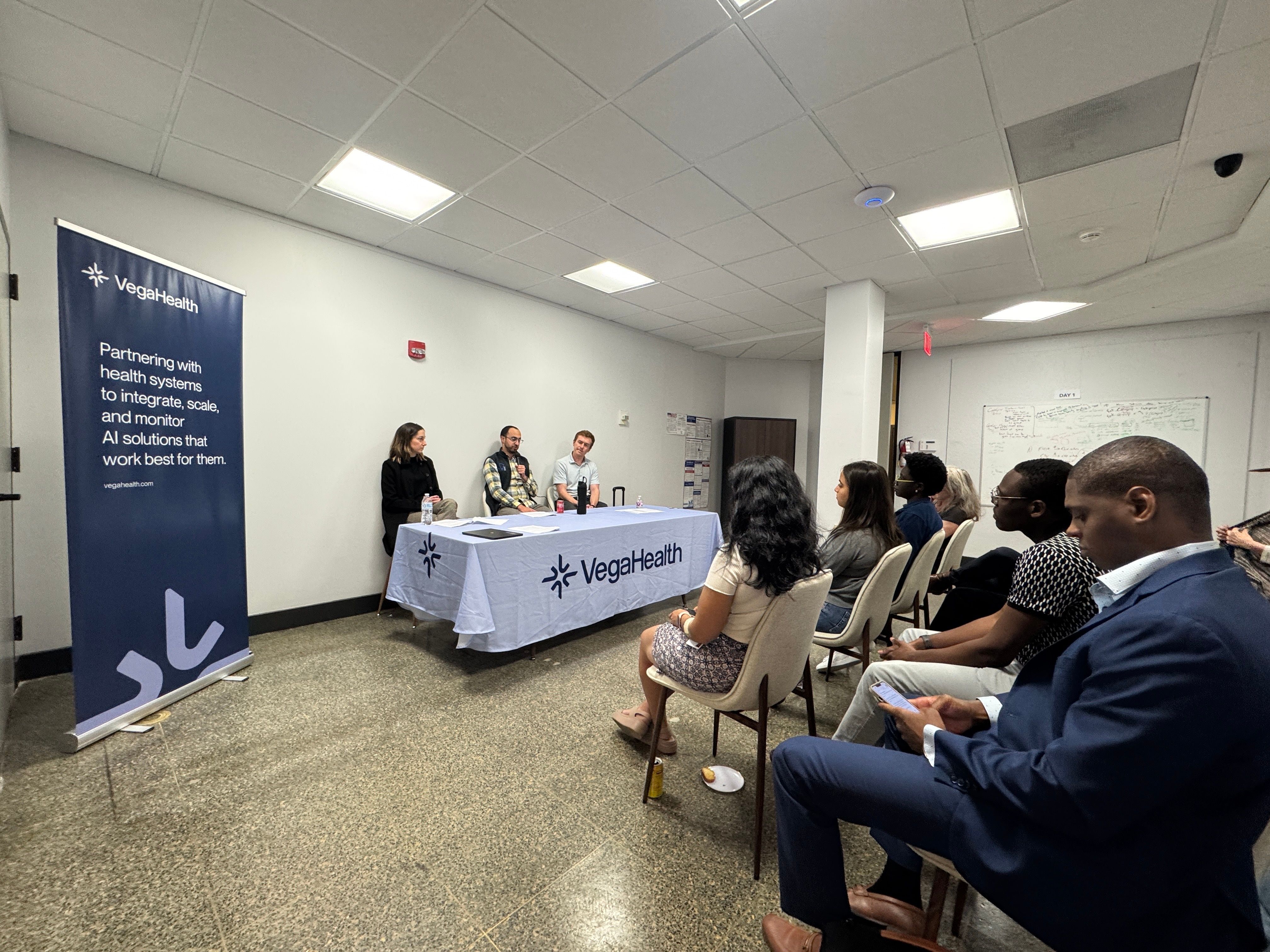
On April 22nd, Vega Health hosted an event for Raleigh-Durham Startup Week. We brought together a genuine mix of startup founders, technologists, and healthcare professionals for a conversation titled Between Innovation and Adoption: The Role of Trust in AI. Moderated by Vega Health CEO Dr. Mark Sendak, the panel featured Kimberly Coston and Will Ratliff, an Innovation Program Manager at the Duke Institute for Health Innovation. Will has led more than 30 AI pilot projects at Duke Health, including the Sepsis Watch™ clinical decision support system.
The conversation covered a lot of ground in under thirty minutes. But two themes kept surfacing, from two different vantage points, in ways that reinforced each other.
One of the biggest problems in healthcare technology continues to be the stage and depth to which frontline end-users are engaged in the development and implementation process
Will framed one of the key factors in DIHI's approach to selecting innovation projects with a question that sounds simple but is often overlooked: Is this problem being raised by the people closest to it?
From there, the DIHI team asks whether a solution is feasible, whether it can be operationalized if it works, and whether early progress can be demonstrated in ways that build momentum for what comes next. It's a framework that treats implementation as part of the innovation, not something that happens after.
His own litmus test for whether an AI solution will be trusted is equally direct: are we solving a real problem for a nurse or physician? Is that problem genuinely getting in the way of patient care? And is the DIHI team addressing both the technical and the non-technical dimensions of that problem?
Kimberly came at the same question from her view as one of the frontline users of these solutions. She opened with an anecdote that put the challenge into context: an AI tool where 100% of nurses surveyed said it gave better responses than existing options, but only 58% wanted to use it, because the workflow friction made it not worth the effort.
Better technology. Lower adoption. The gap between those two numbers is where most healthcare AI initiatives die.
Collaboration means shared ownership, not a weekly Zoom.
The sharpest moment of the evening came when Kimberly pushed back on how "collaboration with frontline staff" tends to get interpreted in practice. Don't mistake collaboration for a physical presence, or a standing meeting, she said. True collaboration requires shared ownership of the problem, the outcomes, and the tradeoffs. And critically: end users need to be inside the development process long before the validation stage - otherwise their involvement becomes a checkbox, not a contribution.
She also raised something that leadership too often overlooks: an organization’s ability to absorb change at a rapid rate. How much change can a health system take on, and at what speed? It's a frontline perspective that too rarely makes it into the room where technology decisions get made, and it's one of the most consequential variables in whether an implementation succeeds.
Will closed the panel by floating an idea: that health systems may need to formalize a clinician-innovator role: someone structurally positioned to bridge the gap between the people building AI solutions and the people whose work those solutions are meant to support.
These aren't questions with clean answers. They're questions that need more people asking them, in more rooms, with more honesty than the industry has typically allowed.
At Vega Health, the insights from Tuesday's panel describe the problems we were founded to solve. But hearing them articulated so clearly, by people working at the frontlines of clinical care and academic innovation, was a reminder of why those problems are worth the work