

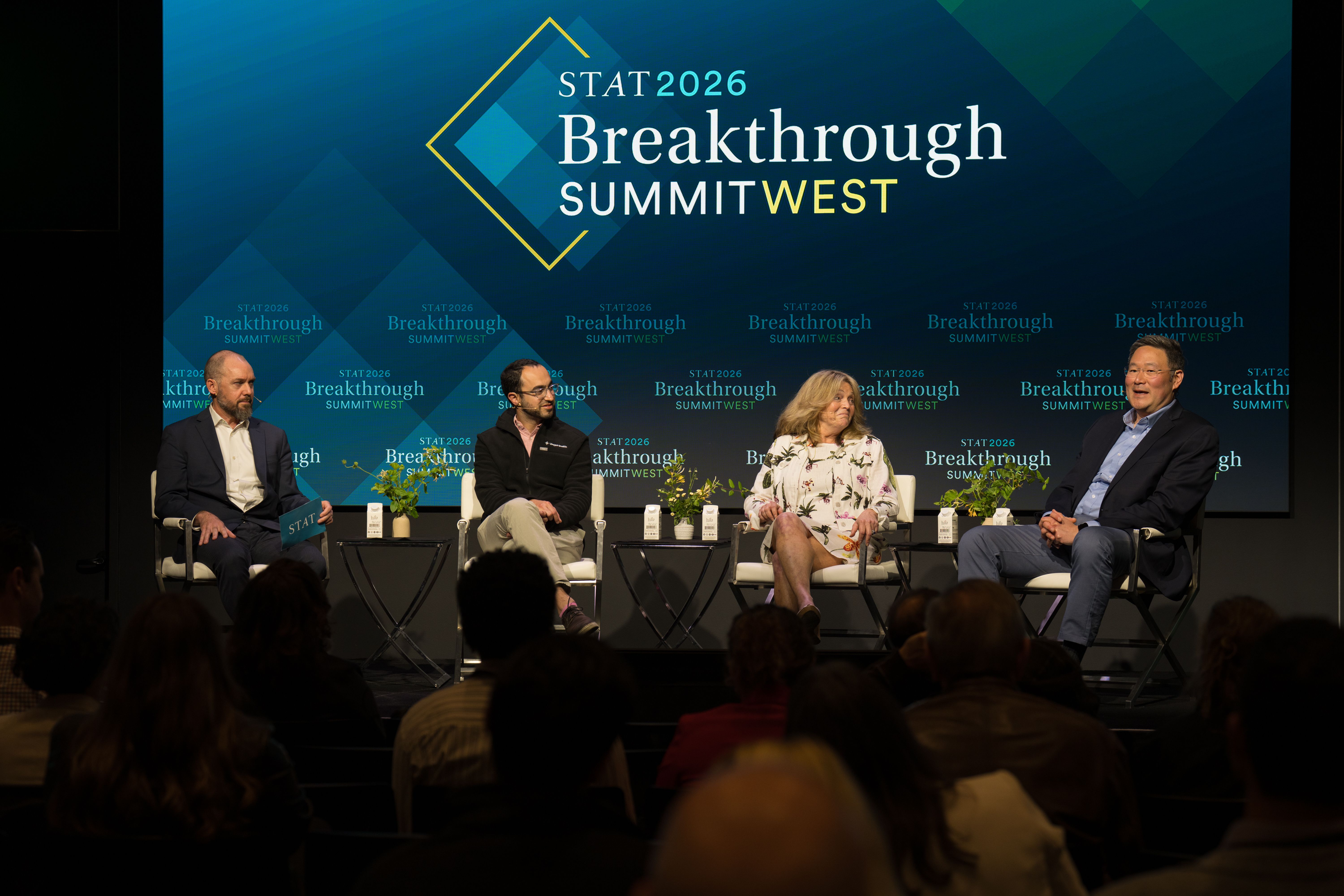
SAN FRANCISCO — Last week, our CEO Mark Sendak joined the STAT Breakthrough Summit West conference for a discussion on the effects of rapid AI development, including the risk widening the digital divide.
He spoke alongside Dr. Vincent Liu, chief data officer of The Permanente Group (right), and Lauren Kopsick, patient advocate and founder of The Health Navigation Project (center). The panel was moderated by STAT’s Chief Investigative Reporter for Data & Technology, Casey Ross (left).
During the panel, Kopsick relayed the frustrations that patients and physicians feel navigating an already broken healthcare system that has layered AI on top of its existing processes. Liu described the massive organization-wide effort that Kaiser Permanente has taken on in order to bring more AI capabilities into its 21 hospitals in Northern California, such as an AI scribe.
Part of Kaiser’s approach to increase uptake has been to leverage a portion of its clinical workforce as “forward deployed engineers” (FDEs) by setting aside time to learn about AI technology and champion it among their peers. This is but one strategy health systems could use to make AI work for them.
Sendak has spent his career at this very intersection, both the creating AI models and ensuring their adoption. What he’s found is this: while no two technology integrations look the same, hands-on support is essential.
Recognizing this reality, Vega Health takes a collaborative approach to problem solving with healthcare delivery organizations. Moreover, our business is built to serve the community health systems that are not a priority for other vendors because of their perceived financial limits and prestige.
This is how you start to close the digital divide: you build for and work for providers in rural and community settings. You listen to their problems and treat them as the experts they are in their own system’s strengths and weaknesses.
Sendak described Vega Health’s approach as growing directly from his experience as a data scientist and model developer at the Duke Institute for Health Innovation, where he spent a decade fixing internal problems facing frontline staff. DIHI had to interface with clinical and operational teams to solve problems collaboratively, but he and others at DIHI realized that federally qualified health centers and community hospitals were at risk of being left behind, while organizations like Duke were making leaps of progress internally.
So, he helped found the Health AI Partnership (HAIP) in 2021, which provides technical assistance to FQHCs to integrate AI into their practices. Despite the critical, hands-on assistance HAIP provides to FQHCs, Sendak realized that it had capacity limitations.
“This is where I think academia falls short,” Sendak said. “We can tell people what to do but actually going out and relieving the burden of every organization to build that capability internally, where, I’ll just be honest, the talent isn’t there and the resources are not there, so how do we relieve that burden?”
Vega Health was founded to solve those restraints.
The ever-widening access gap required a different approach and a different funding source, Sendak said on the panel. This led him to co-found Vega Health in October 2025, alongside Lance Co Ting Keh of Bessemer Venture Partners.
Vega Health helps healthcare delivery organizations implement, scale, and monitor AI for clinical and operational use cases. We partner with health systems to develop tailored solutions that solve their core problems. We are held accountable to our customers’ definitions of success and are transparent in the performance of our solutions.
“It’s easy to think that every health system has a team of data scientists,” Sendak explained. “That folks can take an algorithm, independently assess it, understand how to do post-implementation monitoring. But what I saw in HAIP was not just a void of information, but a void of capabilities to even interpret information. I felt like education, workforce development, capacity building, that work is incredibly important, it has to continue, but it’s not moving fast enough.”
Much of the debate about the use of AI in healthcare today boils down to the incentive alignment of the vendor versus the needs of the end user. The concerns about patient education, clinician adoption, and trust — while legitimate — can be well addressed if the developer solicits feedback from end users during product development. To adequately tailor the technology to meet the needs of clinicians and patients, they need to have a voice from the beginning that helps steer the development and integration of the AI solution.
Other levers to build end-user trust include transparent, ongoing performance monitoring of AI. To date, there are few mandated standards to which AI must be held.
Instead, gold standard performance is usually defined by the vendors who are deploying technology at a health system, sometimes to the detriment of the system and its staff. Health systems tend to have AI governance committees, but in Sendak’s experience they aren’t defining the metrics to which vendors are held accountable.
Sendak built Vega Health because he recognized the risks of rapid AI deployment into a fracturing ecosystem. The window of time to bring community health systems along in the imminent transformation of the healthcare delivery system by AI is closing, and it motivated him to step outside of a comfortable job at an AMC to build Vega Health.
We are grateful for every opportunity to tell our story and participate in prescient conversations about the risks and opportunities that AI presents. Thank you to STAT News for inviting us to this event and to Casey Ross for facilitating a thoughtful conversation.
Mark Sendak was named a STAT News Wunderkind in 2020 for his work centering patients and equity in his work building and implementing ML/AI in healthcare.